


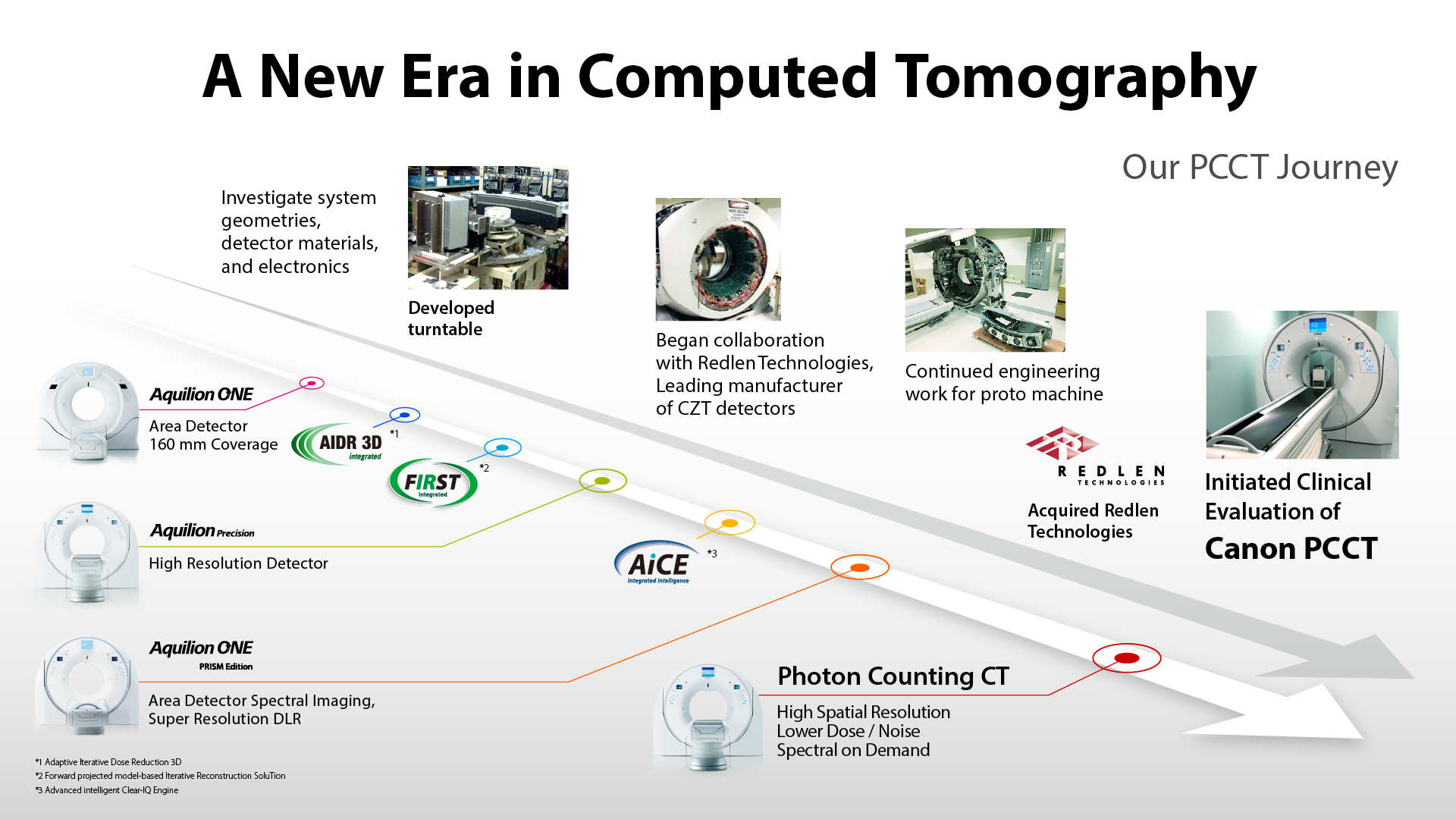
コンピューター断層撮影装置 (CT) の進化は、画像診断学の進歩へと繋がり、その役割は更に大きなものへと成長しています。当社は、エリアディテクターCT、高精細CT、ディープラーニング再構成技術など、CT の能力を飛躍させる多くの革新的技術を開発、製品化してきました。
また、半導体検出器モジュールの設計と製造のグローバルリーダーであるレドレン・テクノロジーズ社(Redlen Technologies Inc., 本社:カナダブリティッシュコロンビア州、以下「レドレン社」)と提携し、テルル化亜鉛カドミウム(CZT)を用いた新たなフォトンカウンティング CT (PCCT) の開発を進めています。
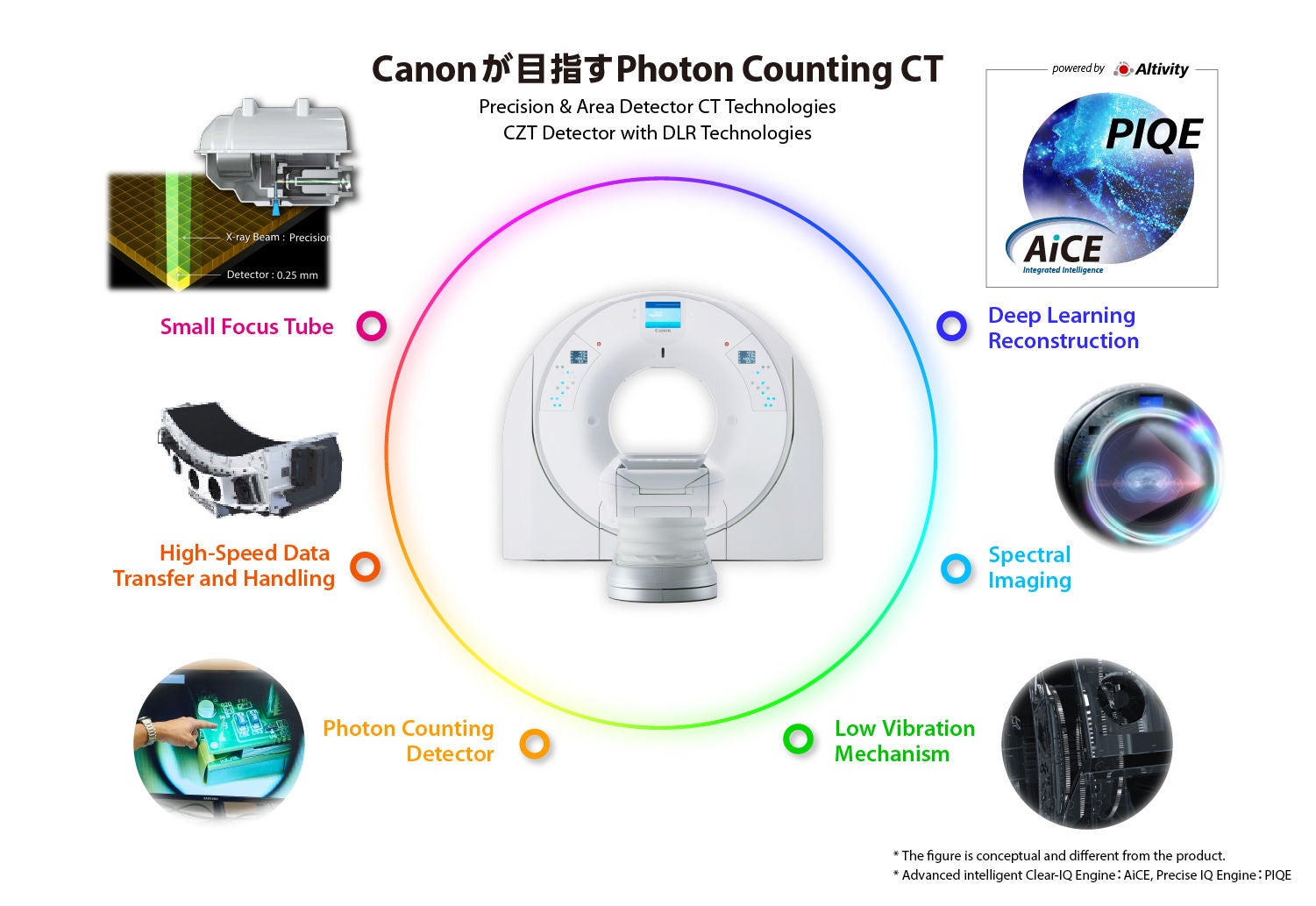
CTの製品化を通して得てきた様々な技術(受光面積に合わせたX線管球設計、架台や寝台の振動抑制機構、大容量データ管理と伝送システム、ディープラーニング再構成技術等)と、X線阻止能や安定性の観点で優れた素質を持つCZT検出器とのシナジー効果により、Canonならではの次世代PCCTを目指します。
また、半導体検出器モジュールの設計と製造のグローバルリーダーであるレドレン・テクノロジーズ社(Redlen Technologies Inc., 本社:カナダブリティッシュコロンビア州、以下「レドレン社」)と提携し、テルル化亜鉛カドミウム(CZT)を用いた新たなフォトンカウンティング CT (PCCT) の開発を進めています。
CTの製品化を通して得てきた様々な技術(受光面積に合わせたX線管球設計、架台や寝台の振動抑制機構、大容量データ管理と伝送システム、ディープラーニング再構成技術等)と、X線阻止能や安定性の観点で優れた素質を持つCZT検出器とのシナジー効果により、Canonならではの次世代PCCTを目指します。
WHAT IS PHOTON COUNTING CT?
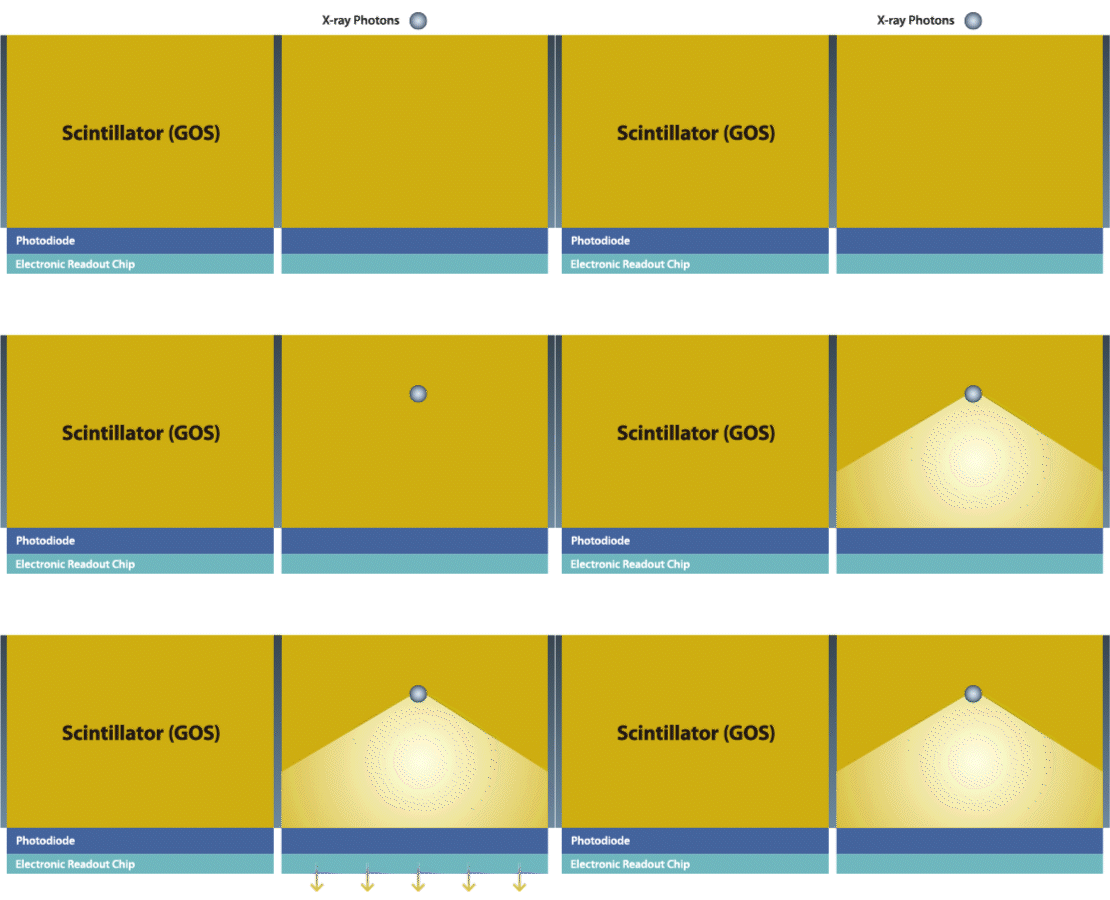
従来CTのエネルギー積分型検出器(EID)は、入射したX線光子をシンチレータで光信号に変換し、その後、フォトダイオードにて電気信号に変換します。この過程で1 つのシンチレータで発生した光が隣接する検出器に散乱する現象(クロストーク)が空間分解能の低下を招きます。そのためEIDではクロストークを防ぐため、シンチレータの間に反射板(隔壁)を設けます。この隔壁はX線検出における不感領域となるため、極力薄く加工し設置する高度な加工技術と組立技術が必須となります。これに対しPCCT は直接変換方式により隔壁が不要となり、X線検出の有効面積を最大限確保することができます。 結果、従来よりも高効率なシグナルの検出が可能となります。
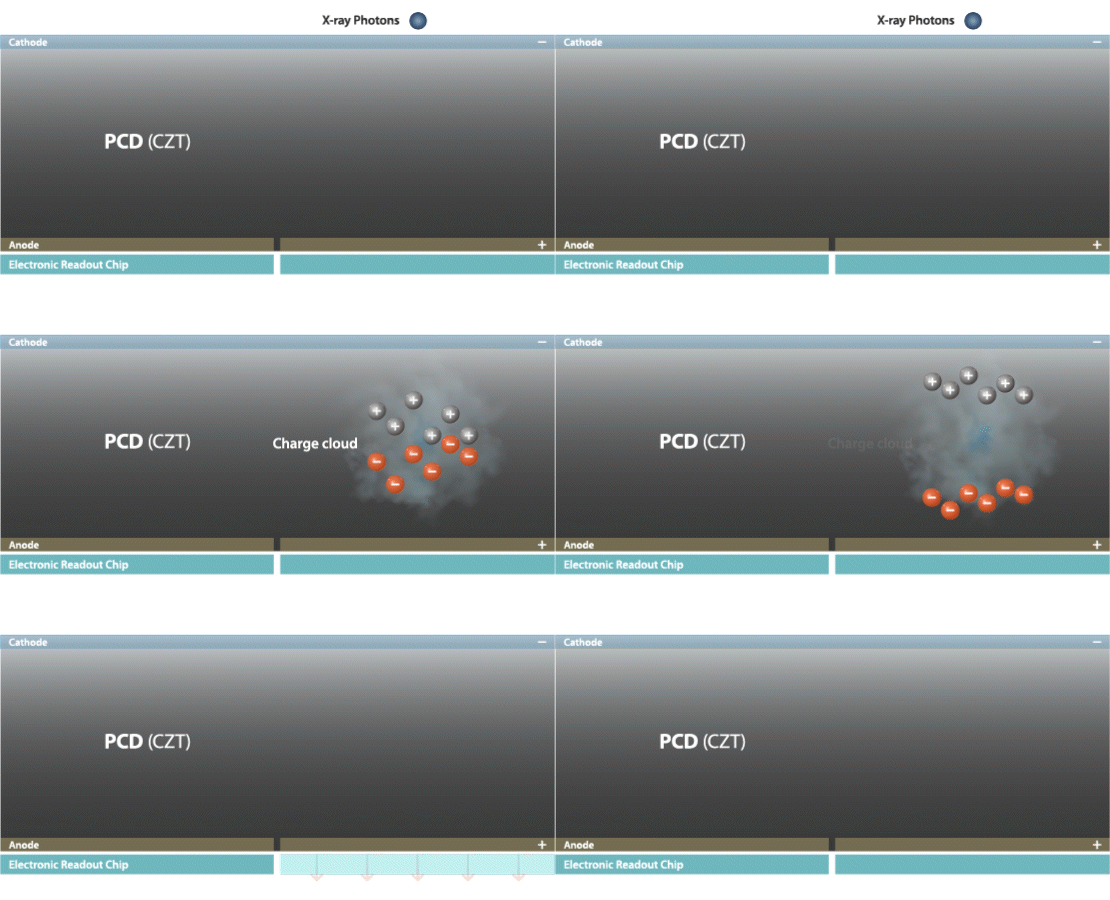
PCCTでは、半導体検出器を用いて、入射したX線光子を電気信号に直接変換します。電気信号はASIC(特定用途向け集積回路)によって読み取られ、各X線光子のエネルギーを個別にカウントします。カウントされたX線光子は測定されたエネルギーに基づいて、複数のエネルギービン(bin)に分類することができ、透過した対象物のX線エネルギー特性を収集することができます。
また、画像再構成に使用するbinを任意に設定することで、電気系ノイズを除去することも可能です。
また、画像再構成に使用するbinを任意に設定することで、電気系ノイズを除去することも可能です。
THE ADVANTAGE OF REDLEN, A CANON GROUP COMPANY
レドレン社は過去20年に渡り高度なCZT製造技術を築き上げた、フォトンカウンティング検出器における世界的な大手サプライヤーです。ここで製造されたCZT検出器は、医療分野のみならず、非破壊検査や航空産業など既に幅広い分野で使用されています。
レドレン社の高精度な CZT 検出器は、X線検出の効率化と、独自のコンパクトな検出器回路を備えています。また、ピクセルサイズの最適化により、パイルアップやチャージシェアリング(半導体検出器における技術的課題)などを効果的に低減しつつ、低ノイズと高解像度の画像生成に繋げます。
レドレン社の高精度な CZT 検出器は、X線検出の効率化と、独自のコンパクトな検出器回路を備えています。また、ピクセルサイズの最適化により、パイルアップやチャージシェアリング(半導体検出器における技術的課題)などを効果的に低減しつつ、低ノイズと高解像度の画像生成に繋げます。
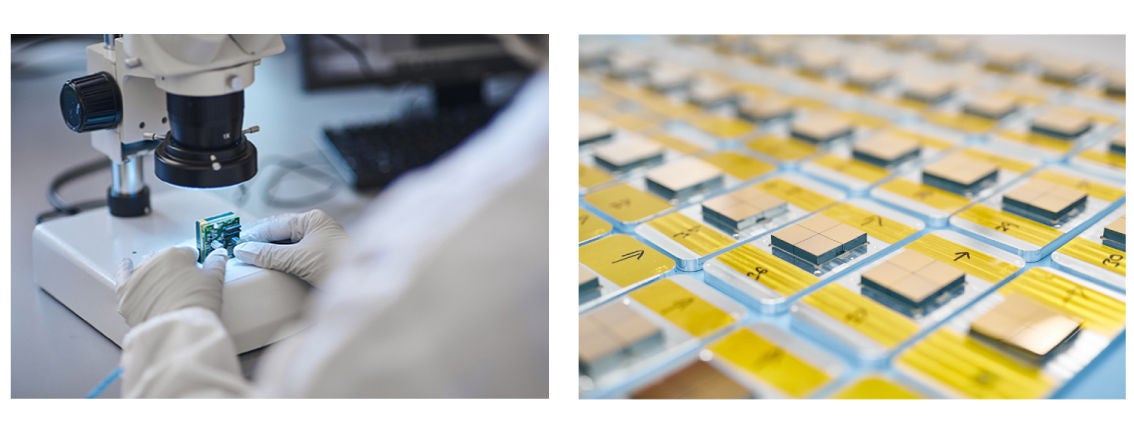
レドレン社では、CZT素材の管理からセンサーの製造と設計、モジュールの組み立てとテストまで、すべてを1つの製造工程で行うことで高品質で安定的な生産を実現しています。また100基以上のCZT製造炉があり、高い製造能力も有しています。
キヤノンの高度なCT製造能力と、レドレン社の強力なCZT検出器製造能力を組み合わせることで、PCCTの安定生産を実現します。
キヤノンの高度なCT製造能力と、レドレン社の強力なCZT検出器製造能力を組み合わせることで、PCCTの安定生産を実現します。
Scientific papers
- H. Kuno, T. Hiyama, T. Sasaki et al. Imaging-detected extranodal extension in head and neck cancer: clinical implications, diagnostic criteria, and the potential of photon-counting detector CT. Jpn J Radiol. 2025 Oct 16. doi: 10.1007/s11604-025-01894-3. Online ahead of print. PMID : 41099987.
- T. Sasaki, H. Kuno, K. Nomura, Y. Muramatsu, K. Aokage, J. Samejima, T. Taki, E. Goto, M. Wakabayashi, H. Furuya, H. Taguchi, T. Kobayashi. CZT-based photon-counting-detector CT with deep-learning reconstruction: image quality and diagnostic confidence for lung tumor assessment. Jpn J Radiol. 2025 Mar 7. doi: 10.1007/s11604-025-01759-9. Online ahead of print. PMID: 40053285.
- Lee D, Zhan X, Tai WY, Zbijewski W, Taguchi K. Improving model-data mismatch for photon-counting detector model using global and local model parameters. Med Phys. 2023 Dec 8. doi: 10.1002/mp.16883. Epub ahead of print. PMID: 38064641.
- Zhan X, Zhang R, Niu X, Hein I, Budden B, Wu S, Markov N, Clarke C, Qiang Y, Taguchi H, Nomura K, Muramatsu Y, Yu Z, Kobayashi T, Thompson R, Miyazaki H, Nakai H. Comprehensive evaluations of a prototype full field-of-view photon counting CT system through phantom studies. Phys Med Biol. 2023 Aug 14;68(17). doi: 10.1088/1361-6560/acebb3. PMID: 37506710
Conference presentations
- F. Tatsugami et al. Impact of Photon-Counting Detector CT on Visualization of the Adamkiewicz Artery Using Super-High-Resolution Mode with Deep Learning Reconstruction: A First Experience. RSNA 2025
- T. Higaki et al. Maximizing Image Quality Through the Synergy of High-Resolution Photon-Counting Detector CT and Deep Learning Reconstruction: A Coronary Phantom Study. RSNA 2025
- T. Sasaki et al. Quantitative Analysis of Pulmonary Emphysema Using Electron Density Images from Photon-Counting Detector CT: Correlation with Pulmonary Function Tests. RSNA 2025
- Kai Mei et al. Photon-Counting Detector CT and Deep Learning Reconstruction in Lung Lesion Assessment. RSNA 2025
- Leening P. Liu et al. Assessing the Utility of Photon-Counting CT in Obese Patients. RSNA 2025
- Fong Chi Ho et al. Task-specific Evaluation of Photon-Counting CT Using a 3D-Printed Anthropomorphic Lung Phantom with COPD Pathology. RSNA 2025
- Yuxin Sun et al. Use of Dark Attenuation Oral Contrast Agent Improves Delineation of Thin Structures at Ultra-High Resolution and Photon-Counting Detector CT. RSNA 2025
- Gisell Ruiz. Association between Detectability Index and Volumetric Accuracy in Low-Dose Energy-Integrating and Photon-Counting CT. RSNA 2025
- Gisell Ruiz et al. Evaluation of Reconstruction Kernels and Resolution Techniques for Volumetric Accuracy of Ground-Glass Opacity Nodules in Low-Dose Photon-Counting CT. RSNA 2025
- W. Y. Tai et al. Impact of Scatter on Phantom-based Water Pathlength Calibration in Photon-Counting CT. 2025 IEEE NPSS
- Leening P. Liu et al. Assessing the Utility of Photon-Counting CT in Obese Patients. 2025 IEEE MIC
- Y. Nakamura et al. Utility of CZT-based photon counting detector CT for an abdominal thin-slice non-contrast CT images in comparison with energy integrating detector CT. ECR 2025
- Y. Nakamura et al. Utility of virtual non-contrast images derived from CZT-based photon counting detector CT in comparison with true non-contrast images. ECR 2025
- H. Kuno et al. Imaging-detected Extranodal Extension in Head and Neck Cancer: Clinical Implications and Diagnostic Criteria in the Era of High-Resolution Imaging including Photon-Counting Detector CT. RSNA 2024
- T. Sasaki et al. CZT-based Photon-Counting-Detector CT with Deep-Learning Reconstruction: Image Quality and Diagnostic Confidence for Lung Tumor Assessment. RSNA 2024
- K. Nomura et al. Sharpness Evaluation of Chest Multi Planar Reconstruction Images with Normal and Super High-resolution Mode of CZT-Based Photon-counting Detector CT. RSNA 2024
- A. Pourmorteza et al. Dose-Efficient Characterization of Coronary Artery Plaques with a Prototype CdZnTe-Based Photon-Counting CT Scanner. SPIE 2024
- A. Pourmorteza et al. Iodine Quantification with a CdZnTe Clinical Prototype Photon-Counting Scanner at Reduced Radiation Dose: Initial Cardiac Phantom Results, ECR 2024
- K. Mei et al. Ultra-low-dose photon-counting CT: Assessing radiomic features with a patient-based lung phantom, ECR 2024
- S. Mochinaga et al. First Results of Electron Density Quantification with CZT-based Photon Counting Detector CT, ECR 2024
- W. Fukumoto et al. Comparison of newly developed CZT-based Photon Counting Detector CT (PCD-CT) and Ultra-High-Resolution CT (U-HRCT) for measuring airway dimensions: A phantom study. ECR 2024
- K. Yokomachi et al. Physical characteristics in slice direction using a newly developed CZT-based Photon-Counting Detector CT. ECR 2024
- Y. Nakamura et al. Accuracy of CT values on virtual monochromatic images of CZT-based Photon Counting Detector CT: comparison with dual-energy CT using energy integrating detector in a phantom model. ECR 2024
- T. Higaki et al. Utility of multi-energy mode of CZT-based Photon Counting Detector CT for coronary CT angiography: A structured phantom study. ECR 2024
- D. Lee et al. Advanced Photon-Counting Detector Simulator with a Count-Rate-Dependent Mapping Operator and a Pixel-to-Pixel Variation Generator. IEEE MSS MIC 2023
- A. Pourmorteza et al. Dose-efficient Ultra-high-resolution imaging of coronary stents with a CdZnTe-based clinical prototype photon- counting scanner. RSNA 2023
- K. L. Boedeker et al. Technical Performance of Super Resolution Deep Learning Reconstruction Algorithm on a Wide Area, Conventional Energy-Integrating Detector vs and a Photon-Counting Computed Tomography System with Conventional Reconstruction Algorithms. RSNA 2023
- T. Sasaki et al. CT Imaging of Lung Cancer: Exploring the Clinical Potential of CZT-based Photon Counting Detector CT. RSNA 2023
- K. Hirayama et al. Super-high-resolution abdominal imaging using CZT based photon counting CT with deep learning reconstruction: quantitative study and first clinical impression. RSNA 2023
- K. Nomura et al. Super-high-resolution chest imaging using CZT-based photon counting CT: performance characterization and first clinical trial. RSNA 2023
- S. Mochinaga et al. High z-axis resolution imaging using CZT based photon counting CT: quantitative study and first clinical trial. RSNA 2023
- Kei Mei et al. Evaluation of a prototype photon-counting CT for pulmonary imaging using patient-based lung phantoms. RSNA 2023
- S. Kondo et al. Visualization of simulated small vessels on photon counting detector CT: comparison with energy integrating CT in a phantom model. RSNA 2023
- T. Higaki et al. Improving spatial resolution in coronary CT angiography with photon counting detector CT: A structured phantom study. RSNA 2023
- T. Higaki et al. Noise reduction in coronary CT angiography with photon counting detector CT: A structured phantom study. RSNA 2023
- F. Tatsugami et al. Coronary Artery Calcium Volume Measurement: A Comparison between Photon-Counting CT and Ultra-High-Resolution CT using a Cardiac CT Calibration Phantom. RSNA 2023
- K. Nomura et al. Basic Image Quality Evaluation of New Platform Prototype Photon Counting CT. JRC 2023
- X. Zhan et al. Spectral imaging performance evaluation for a prototype full-size photon counting CT system at clinical dose levels. JRC 2023
- R. Zhang et al. Quantitative image quality comparison between normal resolution and super high resolution modes of a clinical prototype photon counting CT system. JRC 2023
- T. W. Holmes et al. Pediatric head and neck imaging with a CZT-based photon-counting CT scanner: initial image quality evaluation. ECR 2023
- K. Nomura et al. Comparison of CT image quality for different sized phantom between prototype full-size photon counting and conventional CT systems: CT number, image noise and artifact. ECR 2023
- Edgar Salazar et al. Evaluation of a prototype photon-counting CT for low-dose pulmonary imaging using patient-based lung phantom. ECR 2023
- X. Zhan et al. A study of cross-talk effect in pixelated photon counting detectors and impact to system imaging performance. SPIE 2023
- Donghyeon Lee et al. Photon-Counting Detector Model Using Local Parameters for Pixel-to-Pixel Variation. SPIE 2023
- W. Yang Tai et al. Effects of Bowtie Scatter on Material Decomposition in Photon-Counting CT. SPIE 2023
- R. Zhang et al. Quantitative Image Quality Comparison between Photon Counting and Conventional CT Systems: Contrast-to-Noise Ratio. RSNA 2022
- K. L. Boedeker et al. Low Contrast Detectability Comparison Between a Prototype Photon Counting Computed Tomography System and Conventional CT system Across a Range of Attenuation Levels. RSNA 2022
- Xiaohui Z et al. Quantitative image quality evaluation for a prototype photon counting CT through phantom studies: Noise, Resolution and Quantitative Accuracy. CERN SpecXray 2022
- A. Pourmorteza et al. First experience with a clinical prototype CZT-based PCCT scanner: applications in low-dose lung cancer screening. CERN SpecXray 2022
- Xiaohui Z et al. Phantom imaging evaluations of a prototype CZT based photon counting system. ECR 2022
- K. Nomura et al. Quantitative image quality comparison between a prototype full-size photon counting CT system and conventional CT systems with energy integrating detectors. ECR 2022
- T. W. Holmes et al. Low-Dose Lung Cancer Screening with a Novel CZT Photon-Counting CT Prototype: A Phantom Study. ECR 2022
- Y Suzuki et al. Physics Performance Evaluation of Prototype Photon Counting CT: Basic Image Quality Evaluation. JRC 2022
- K. Nomura et al. Physics Performance Evaluation of Prototype Photon Counting CT: Quantitative Evaluation. JRC 2022
- Y. Muramatsu et al. Physics Performance Evaluation of Prototype Photon Counting CT: Large-phantom Evaluation. JRC 2022
- Xiaohui Z et al. First results from a prototype full-size photon counting CT system: counting and spectral imaging performance at clinical dose levels. RSNA 2021
- K. Nomura et al. Quantitative image quality comparison between photon counting and conventional CT systems: noise, resolution and quantitative accuracy. RSNA 2021
プレスリリース
August 31, 2021
フォトンカウンティングCT 日本初の実用化に向けて、国立がん研究センターと共同研究を開始
November 7, 2022
国産初 フォトンカウンティング検出器搭載型X線CTを国立がん研究センター先端医療開発センターに設置
April 11, 2023
国産初の次世代フォトンカウンティングCTを目指した臨床研究開始
November 17, 2023
キヤノンメディカル、次世代フォトンカウンティングCT実現に向けたグローバルな臨床研究を加速
February 26, 2024
ラドバウド大学メディカルセンターとフォトンカウンティングCTの臨床研究を開始
April 8, 2024
広島大学とフォトンカウンティングCTでの臨床研究を開始
November 27, 2024
キヤノンがフォトンカウンティングCTの実現に向けて米国ペンシルベニア大学のPenn Medicineと共同研究を開始
April 9, 2026
国産初のフォトンカウンティングCT“Ultimion”を発売 診断精度のさらなる向上と被ばく線量の低減が期待される次世代CT
フォトンカウンティングCT 日本初の実用化に向けて、国立がん研究センターと共同研究を開始
November 7, 2022
国産初 フォトンカウンティング検出器搭載型X線CTを国立がん研究センター先端医療開発センターに設置
April 11, 2023
国産初の次世代フォトンカウンティングCTを目指した臨床研究開始
November 17, 2023
キヤノンメディカル、次世代フォトンカウンティングCT実現に向けたグローバルな臨床研究を加速
February 26, 2024
ラドバウド大学メディカルセンターとフォトンカウンティングCTの臨床研究を開始
April 8, 2024
広島大学とフォトンカウンティングCTでの臨床研究を開始
November 27, 2024
キヤノンがフォトンカウンティングCTの実現に向けて米国ペンシルベニア大学のPenn Medicineと共同研究を開始
April 9, 2026
国産初のフォトンカウンティングCT“Ultimion”を発売 診断精度のさらなる向上と被ばく線量の低減が期待される次世代CT
免責事項: Note
・このページはキヤノンが目指すフォトンカウンティングCTの姿を示す企業広告になります。
・臨床画像はすべてCTスキャナTSX-501Rで撮影されたものです。
・このページはキヤノンが目指すフォトンカウンティングCTの姿を示す企業広告になります。
・臨床画像はすべてCTスキャナTSX-501Rで撮影されたものです。
Social Media


